

Week 3 — Fall Protection Fundamentals: Why the #1 OSHA Violation Is Still the #1 Killer
Falls from elevation are the leading cause of death in construction. Every year. Every published OSHA Top 10 list since at least 2010 has put fall protection — 29 CFR 1926.501 — at the top of the cited‑violations list. The standard is one of the oldest, best‑known, and most widely trained in the industry. And yet, in the United States, a worker dies from a fall roughly every other day on a construction site.
When I'm retained as an expert witness in fall fatality cases, the failure pattern is consistent. The worker was within reach of compliant fall protection. They knew it was required. The crew had used it on previous days. And on the day of the fall, for one reason or another — speed, frustration with the gear, a "five‑minute" task that became thirty — the protection was bypassed.
This isn't a knowledge problem. It's a system problem. And the standards are written assuming that the system is what saves the worker, not their judgment in the moment.
What 29 CFR 1926.501 Actually Requires
In construction, the trigger for fall protection is six feet. 29 CFR 1926.501(b)(1) states that each employee on a walking/working surface with an unprotected side or edge that is six feet or more above a lower level shall be protected from falling by guardrail systems, safety net systems, or personal fall arrest systems.
The standard then walks through specific applications:
Leading edges (1926.501(b)(2)). Six feet, same protections, with engineering controls preferred.
Hoist areas (1926.501(b)(3)). Guardrails or PFAS at the edge of any hoist area.
Holes (1926.501(b)(4)). Covers or guardrails on every hole through which a worker could fall, or through which an object could fall (a tool dropped through a deck hole onto a worker below is just as fatal).
Formwork and reinforcing steel (1926.501(b)(5)). Positioning device or PFAS at six feet.
Ramps, runways, and other walkways (1926.501(b)(6)). Guardrails on each side six feet or more above lower levels.
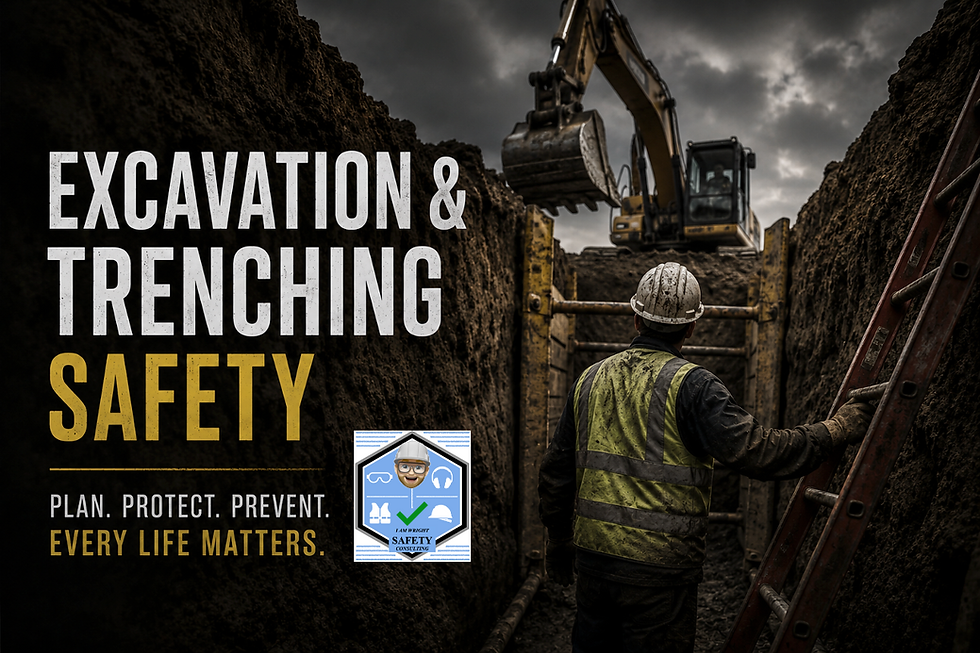
Excavations (1926.501(b)(7)). Guardrails or covers for excavations six feet or more deep that are not readily seen.
Roofing work (1926.501(b)(10) and (b)(11)). Specific systems for low‑slope and steep‑slope roofs, with the warning‑line + safety‑monitor allowance only for roofs with a slope of 4:12 or less and only with the full system in place.
Wall openings (1926.501(b)(14)). Guardrails, safety nets, or PFAS for any wall opening with the lowest point of the opening less than 39 inches above the walking/working surface and the outside drop is six feet or more.
In general industry, the parallel standards are 29 CFR 1910.28, .29, and .30, with a four‑foot trigger height for most walking/working surface fall hazards.
The Three Components of a Personal Fall Arrest System — and the One Most Often Wrong
A compliant PFAS has three parts: the anchorage, the connecting subsystem, and the body harness (the "ABC" mnemonic). Of the three, the anchorage is the most often overlooked.
29 CFR 1926.502(d)(15) requires anchorages to be capable of supporting at least 5,000 pounds per attached worker, or be designed, installed, and used as part of a complete PFAS that maintains a safety factor of at least two under the supervision of a qualified person. That's not a number that "feels strong." It's not a strut, a piece of conduit, a hand‑rail, a bridle ring, or a sprinkler line. I have reviewed cases where the worker's lanyard was tied to a piece of unistrut bracketed to a duct, and the worker had taken every step of personal protection right up to the point where the anchorage failed at less than 800 pounds and they fell 22 feet.
The connecting subsystem — typically a lanyard with a shock absorber, or a self‑retracting lifeline — must be selected for the actual fall distance available. A six‑foot shock‑absorbing lanyard requires a minimum of 18.5 feet of clearance below the anchorage to fully deploy. If the worker is 12 feet up with a six‑foot lanyard tied off at their feet, the math does not work — they will hit the ground before the system arrests the fall. Calculating fall clearance is a fundamental competent‑person skill that training programs often skip.
The body harness must fit, must be inspected before each use, and must be retired according to the manufacturer's criteria. A harness that has arrested a fall is done — it does not go back into service. That seems obvious until you find one in a gang box still on the schedule.
Where Fall Protection Programs Quietly Fail
In my consulting and expert witness work, the same program failures recur:
No site‑specific fall protection plan. Required by 1926.502(k) for leading‑edge work, precast concrete erection, and residential construction when conventional protection is infeasible. The plan must be written, must identify the alternative measures, and must be available on site. I have requested these in discovery and been handed a blank template.
Anchorage points were never identified or rated. Crews "find" anchorage in the field. The anchorages used were never engineered, never tested, and there is no written record of where workers were authorized to tie off.
Self‑retracting lifelines used in foot‑level tie‑off configurations. Most SRLs are rated for tie‑off at or above the dorsal D‑ring. Tying off at foot level requires a Class B SRL specifically designed and rated for that use — which is a small fraction of the SRL population in the field. Misuse here means a fall arrest that exceeds the maximum arresting force the worker's body can tolerate.
No rescue plan. A worker suspended in a harness after a fall is not safe — they are now in a race against suspension trauma. 1926.502(d)(20) requires the employer to provide for prompt rescue. "Call 911" is not a rescue plan, for the same reasons it isn't one in confined spaces.
Inspection: The Cheapest Mitigation You Aren't Doing
Daily user inspection of harnesses and lanyards is required under both manufacturer instructions and OSHA general duty principles. Annual competent‑person inspection is required by most manufacturer instructions and is the industry standard of care. The form is usually four lines on a card. The time to perform it is under five minutes. I have reviewed PFAS pulled from gang boxes after fatal falls and found webbing cuts, missing stitching at the shock pack, and corroded snap hook gates that any user inspection would have caught.
If your fall protection program does not have a written inspection schedule, a tag system identifying inspection dates, and a retirement procedure for damaged equipment, that is the cheapest gap to close in your entire safety program.
What to Do This Week
For fall protection, three concrete steps to take in the next seven days:
Walk one active site at the end of the workday. Identify every elevated work surface, pick the one with the worst fall exposure, and ask: would a worker who fell from this point right now be saved by the system in place? If the answer is "depends on what they remembered to do," the system is not the system — the worker is.
Pull every PFAS in active service and confirm there is documentation of the most recent competent‑person inspection. Anything without a current tag goes out of service today.
Verify the rescue plan in your program names a real method, real equipment, and real responders — not a phone number.
IamWright Safety Consulting builds fall protection programs, trains competent persons and authorized users, and provides expert testimony in fall fatality and serious injury litigation. We have testified on residential roofing falls, leading‑edge falls in commercial construction, and tower climber fatalities — and the common thread is always the same: the standard was knowable, the protection was available, and the system did not survive contact with a real workday.
For consulting, training, or expert witness inquiries, please contact us using the contact form.
David Wright is the owner of IamWright Safety Consulting and serves as Director of Safety & Health, Construction at CDM Smith. He has trained, audited, and testified on fall protection programs across construction, utility, and industrial sectors.

Comments